In the digital age, information is the most valuable currency, but it is also the most fragile. As we migrate our entire lives from legal contracts to creative works into the digital realm, we face a critical challenge: How can we prove that a piece of data is authentic and hasn't been altered? Traditional systems rely on central authorities, but these are single points of failure. The solution lies in the mathematical certainty of Cryptographic Hashing and the permanent record of Blockchain Anchoring.
1. The Philosophy of Digital Truth
For decades, our society has functioned on "institutional trust." We trust banks to keep our ledgers accurate, we trust notaries to witness our signatures, and we trust social media platforms to maintain our digital history. However, this model is centralized and opaque. When a database is hacked or a record is silently deleted, the "truth" vanishes.
Blockchain technology introduces a new paradigm: Algorithmic Trust. By using hashing and blockchain anchoring, we move away from "believing" an institution and toward "verifying" the math. This is the foundation of a trustless society, not a society without trust, but one where trust is so deeply embedded in the infrastructure that it no longer needs to be granted to middlemen.
2. Cryptographic Hashing: The Immutable Fingerprint
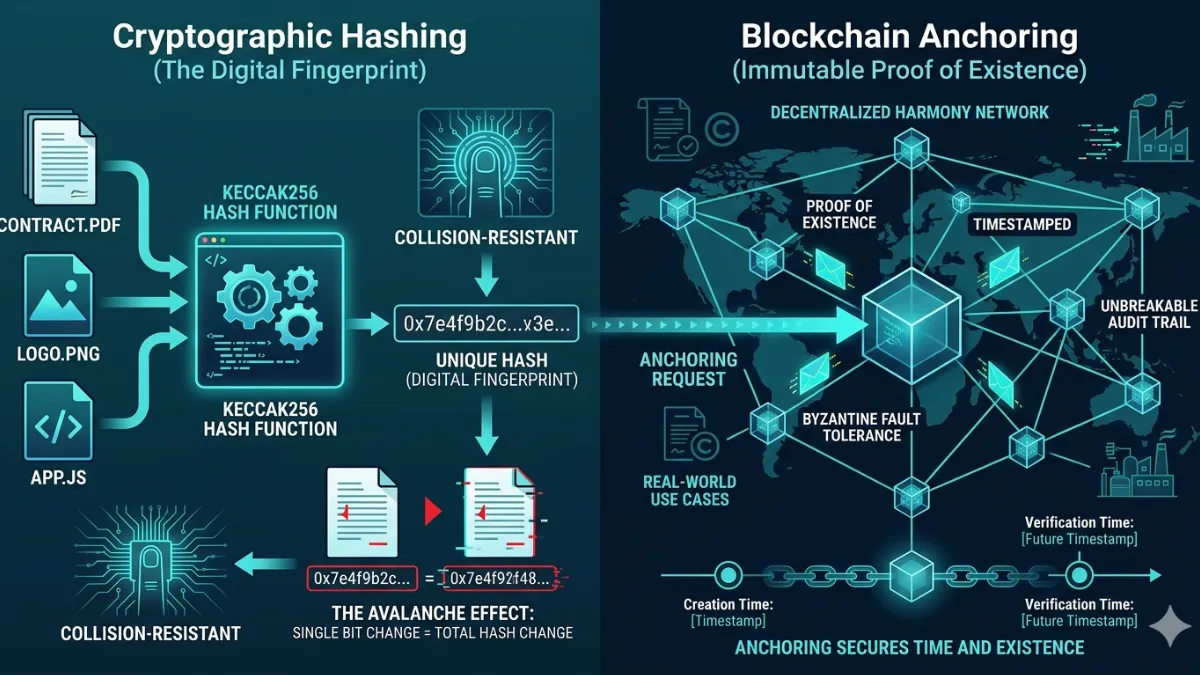
To understand how we secure data, we must first understand the Hash Function. A hash function (like Keccak256) is a mathematical algorithm that takes any input, a single word, a high-resolution image, or a massive database, and condenses it into a unique, fixed-length string of characters.
2.1 The Avalanche Effect
One of the most critical features of a high-quality hash function is the Avalanche Effect. This means that if you change even a single bit of the input data, the resulting hash will be completely and unrecognizably different. This makes hashing the ultimate tool for Integrity Verification. If you have the original hash of a file, you can instantly prove if that file has been tampered with, even years later.
2.2 Deterministic and Collision-Resistant
A hash is deterministic: the same input will always produce the exact same hash. Simultaneously, it is collision-resistant, meaning it is statistically impossible for two different inputs to produce the same hash. This uniqueness is what allows us to use a hash as a Digital DNA for any piece of information.
3. Blockchain Anchoring: Securing Time and Existence
A hash proves that a file is what it claims to be, but it doesn't prove when that file existed. By Anchoring a hash to a blockchain, we attach a permanent, decentralized timestamp to that digital fingerprint.
3.1 From Local to Global
When you use a tool like DevFlavor, the hashing happens locally on your machine. Your private data never leaves your browser. Once the hash is generated, it is sent as a transaction to the Harmony Blockchain. The network's nodes verify the transaction and include it in a block. At this moment, your hash becomes part of a global, immutable chain of history.
3.2 The Power of Immutability
In a traditional database, records can be edited or deleted (CRUD operations). In a blockchain, the ledger is append-only. Once a hash is anchored, it cannot be removed. It is protected by the combined computational power of the network. To alter that record, an attacker would have to rewrite the entire history of the blockchain, a task that is practically impossible in a decentralized environment.
4. Real-World Benefits of Anchoring
4.1 Legal and Contractual Integrity
Imagine a legal contract signed digitally. By anchoring the hash of that contract on the blockchain, both parties have an undeniable proof of the original agreement. If one party tries to present an altered version of the contract in court, the hashes will not match, and the fraud will be exposed immediately. This effectively turns the blockchain into a Global Digital Notary.
4.2 Intellectual Property Protection
For creators, artists, writers, and engineers, blockchain anchoring provides a "Proof of Creation." By hashing a work-in-progress and anchoring it, a creator establishes a timestamped record of their idea. This can be used as evidence in copyright disputes to prove that they were in possession of the work at a specific date and time.
4.3 Supply Chain and Logistics
In supply chains, data integrity is a matter of safety. Anchoring the hashes of inspection reports, temperature logs for food, or manufacturing certificates ensures that the data hasn't been "beautified" after the fact. It guarantees a Transparent Audit Trail from the factory floor to the consumer's hands.
5. Technical Deep Dive: Keccak256 on Harmony
Why do we use Keccak256? While many are familiar with SHA-256 (used by Bitcoin), Keccak256 is the cryptographic heart of the Ethereum Virtual Machine (EVM) and networks like Harmony. It offers superior resistance to certain types of cryptographic attacks and is optimized for the smart contract environment.
By choosing the Harmony Network for anchoring, we leverage its 2-second finality. This means that your data anchor is confirmed almost instantly, providing a seamless user experience while maintaining the high security standards of a sharded, proof-of-stake blockchain.
[ SUMMARY_REPORT ]
Hashing provides the integrity; Blockchain provides the permanence. Together, they create a system where data is no longer a matter of opinion, but a matter of mathematical fact. By anchoring hashes, we are not just saving data, we are securing the truth.
6. Conclusion: Securing the Future
As we move further into a decentralized future (Web3), the tools we use to verify information must be as robust as the information itself. Hashing and blockchain anchoring are not just technical features; they are the guardians of digital heritage. Whether you are protecting a personal document, a corporate record, or a creative masterpiece, anchoring your hash on the blockchain ensures that your digital footprint remains visible and untampered for generations to come.